
This Is Not the First Menopause Moment
The conversation about hormone therapy feels urgent and new right now. Social media is full of it. Podcasts are devoted to it. Women are seeking out menopause specialists in numbers the field has never seen. The Menopause Society has grown from 2,000 members when I joined in 2007 to now 12,000 in 2026. There is a sense that we are living through a breakthrough moment in how menopause is understood and treated.
But this is not the first time that moment has happened. Hormone therapy has surged and collapsed before - twice. And understanding that history is essential to understanding why so many women today are confused, undertreated, and carrying a fear of hormones that was shaped by events that happened before they ever asked a single question about menopause.
This is a little history lesson. Remember, history often repeats itself :)
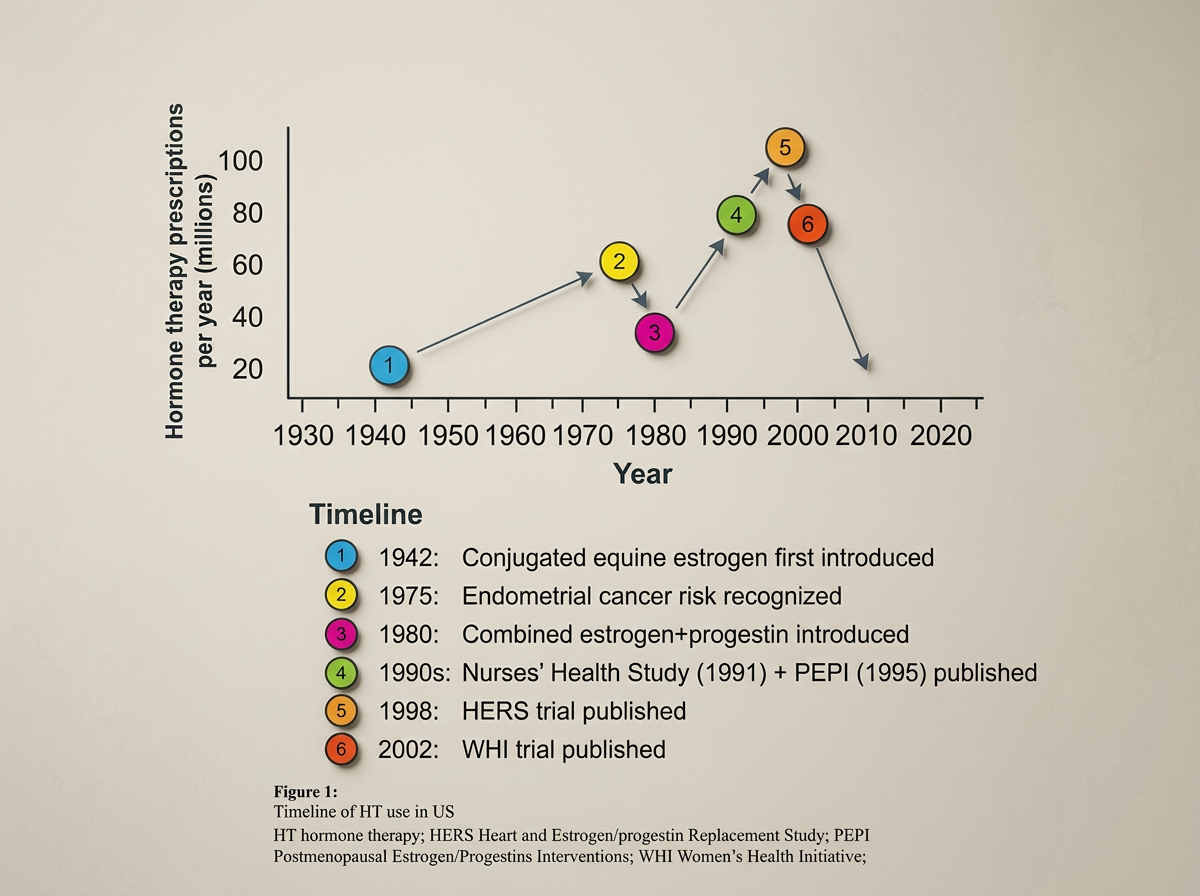
Figure from Rethinking Menopausal Hormone Therapy: For Whom, What, When and How long? By Cho et al. Published in Circulation 2023 February.
Part One: Feminine Forever and the First Surge
The modern era of hormone therapy began in 1966 with the publication of a book called Feminine Forever by American gynecologist Robert Wilson. The premise was simple and seductive: estrogen was the essence of femininity, menopause was a deficiency disease, and hormone replacement could keep women youthful, vital, and sexually relevant indefinitely.
The book was a cultural phenomenon. It sold over 100,000 copies in its first year. Wilson appeared on television, was featured in major magazines, and positioned estrogen, specifically conjugated equine estrogen, sold under the brand name Premarin, as a fountain of youth for aging women. The framing was not subtle. Women who did not take estrogen were described as living in a state of decay. Menopause was not a natural transition; it was a hormone deficiency to be corrected.
Premarin prescriptions surged through the late 1960s and into the 1970s. By 1975, it was one of the most prescribed medications in the United States. Hard to believe! Women were taking estrogen alone, unopposed, as we now call it, often for years, in pursuit of the feminine vitality Wilson had promised.
But, this did not lead to happy endings.
The First Downfall: Endometrial Cancer
In 1975, two landmark studies published in The New England Journal of Medicine reported a finding that stopped the prescribing surge cold in its tracks: women taking unopposed estrogen, estrogen without progesterone, had a dramatically elevated risk of endometrial cancer, the cancer of the uterine lining.
The mechanism, in retrospect, was straightforward. Estrogen stimulates the growth of the uterine lining. Without progesterone to counterbalance that stimulatory effect and trigger regular shedding, the endometrium can proliferate unchecked. Unchecked proliferation is the substrate for malignancy. Women with an intact uterus who were taking estrogen alone were, in effect, receiving continuous uterine stimulation with no protective counterpart. For this reason, this is why if you have a uterus, you also have to take a progestogen (continuously or sequentially).
The relative risk was striking. Studies estimated that women on unopposed estrogen had four to eight times the risk of endometrial cancer compared to non-users. Prescriptions collapsed almost immediately. Women who had been on estrogen for years stopped it (hmmm - sound familiar?). Physicians who had been enthusiastic prescribers became wary (also sound familiar?). The cultural moment Wilson had created evaporated, and it took the medical establishment with it.
The scientific response, however, was not to abandon hormone therapy. It was to fix it. By the late 1970s, the field had established that adding a progestogen to estrogen therapy, for women with an intact uterus, effectively neutralized the endometrial cancer risk. Combined estrogen-progestogen therapy became the new standard, and the crisis, while real, had a solution.
But the damage to public confidence was done.
Part Two: The Second Surge & The Nurses' Health Study and Cardiovascular Hope
Through the 1980s, a new body of evidence began to accumulate that gave the field reason for renewed enthusiasm. This time grounded not in promises of eternal youth, but in data about serious disease prevention. There was a shift from protecting femininity to protecting long-term health and reduced morbidity and mortality. Quite a different tune.
The Nurses' Health Study, one of the largest and longest-running investigations of women's health ever conducted, following over 120,000 nurses beginning in 1976, was generating observational findings that pointed toward a significant cardiovascular benefit of hormone therapy. Women who took postmenopausal estrogen appeared to have substantially lower rates of coronary heart disease than women who did not. Across multiple analyses through the 1980s and into the 1990s, the data were consistent: hormone therapy users had roughly 40 to 50 percent lower risk of heart disease.
For a medical community that understood estrogen's cardioprotective biological effects, its favorable impact on lipid profiles, endothelial function, and insulin sensitivity, these findings were biologically plausible and clinically exciting. Cardiovascular disease was already recognized as the leading killer of women. The prospect of a medication that could dramatically reduce that risk was not a minor clinical finding. It was potentially transformative.
Prescribing surged again. Through the 1990s, hormone therapy became not just a treatment for menopausal symptoms but a preventive cardiovascular strategy. Clinicians were counseling postmenopausal women to consider hormones not because they had hot flashes, but because their heart might benefit. By the late 1990s, combined estrogen-progestogen therapy was one of the most commonly prescribed medications in the country - once again.
The Second Downfall: The Women's Health Initiative
Based on the observational findings from The Nurse’s Health Study, the National Institute of Health wanted to design the gold-standard randomized control trial to study these findings. In July 2002, the estrogen-plus-progestin arm of the Women's Health Initiative, a large, federally funded randomized controlled trial, was halted early. The headlines were immediate and alarming: hormone therapy caused breast cancer. It caused heart disease. Women should stop taking it. Physicians should stop prescribing it. These headlines were a mis-representation of the data for many reasons: the average age studied was 63, only 12% of women were symptomatic from hot flashes and night sweats, it was only powdered to study risk on cardiovascular disease not breast cancer, and it only studied one formulation of hormone therapy.
Nonetheless, the effect was swift and dramatic. Within months, prescriptions dropped by more than 50 percent. Women stopped their medications overnight, often without guidance. Physicians who had been enthusiastic prescribers became unwilling to prescribe at all. Medical education pivoted to treat hormone therapy as dangerous, and a generation of clinicians was trained under that assumption. Not all women stopped, and when I meet those women I spend extra time to ask about their experience and their decision to continue - it’s almost like asking someone who found speakeasy’s during prohibition. That’s how taboo menopausal hormone therapy prescribing and taking has/had become.
The consequences of the WHI, for millions of women left without treatment for debilitating menopausal symptoms, were profound and largely invisible. They did not generate headlines.
I’ll repeat this again, because it’s important: what went largely unreported was the extent to which the WHI findings had been misinterpreted and overgeneralized. The average participant was 63 years old; this is more than a decade past typical menopause onset. The study used a single formulation: oral conjugated equine estrogen combined with synthetic medroxyprogesterone acetate. The breast cancer risk that generated the most panic was a small absolute increase, reported in relative terms that made it sound catastrophic, and was not statistically significant (you know, that annoying p value scientists are always talking about). And the estrogen-only arm of the trial, for women without a uterus, actually showed a reduction in breast cancer risk, a finding that received a fraction of the attention. Side note - this reduction has been demonstrated with conjugated equine estrogen and not estradiol - not all hormones are created equal.
The Nurses' Health Study had been observational. This means it could show association, not causation. The WHI was designed to be the definitive trial. But it studied the wrong population, used a specific formulation, and its conclusions were applied broadly to all women and all hormone formulations in ways the data could not support. In my humble opinion, that seems rather silly. We do not do this in any other area of medicine.
What Was Lost
A 2013 analysis estimated that between 2002 and 2012, as many as 91,000 postmenopausal women may have died prematurely from causes that adequate hormone therapy might have helped prevent: cardiovascular disease, osteoporosis, the downstream consequences of untreated estrogen deficiency. That is a decade of harm that happened not from prescribing too much, but from prescribing too little.
What the current moment represents is the surge in menopause awareness, the growing number of specialist practices, the Menopause Society's updated position statements, the 2026 ACC/AHA guidelines that recognize female-specific cardiovascular risk. This is all an effort correcting the overcorrection of 2002. It is not a new discovery that hormones are beneficial for many women. It is a return to what the evidence has actually supported across decades, interrupted twice by moments of crisis that were real but mishandled.
What did we learn?
The endometrial cancer crisis of 1975 had a solution: add progesterone. It changed the standard of care and improved it.
The WHI crisis of 2002 has a more nuanced correction: use the right formulation, for the right patient, at the right time. This is exactly what the timing hypothesis and current individualized prescribing guidelines describe.
Why This History Matters for You
If you carry fear about hormone therapy, if you were told by a physician that hormones were dangerous, or if you stopped a medication that was helping you because of something you read in 2002, that fear has a history. It was shaped by real events, imperfectly reported and incompletely corrected, that calcified into medical culture for two decades.
Understanding that history does not erase the real risks that exist. Hormone therapy, like every medical intervention, has a benefit-risk profile that requires individual assessment. But it does contextualize the fear, and it makes clear that the current evidence-based approach to hormone therapy is not a radical new experiment. It is the latest chapter of a long story that medicine is finally, belatedly, telling more honestly.
Is hormone therapy for everyone? Absolutely not. Is it the answer for longevity? Also absolutely not. Does every woman deserve a well-informed approach to menopausal hormone therapy? Absolutely.
This post is intended for educational purposes and reflects the clinical perspective of Christina Saldanha, PA-C, founder of Camel City Women's Wellness.
