
Do you ever wish there was a way to track your patients hormones? There is - let me show you how.
Book a complimentary consultation with me to discuss your Mira hormone tracking case. I will offer expert insight with an experienced perspective.
*note this is only for clinicians and no medical advice will be given
You’ve been told that hormone tests don’t matter. They do. But, only if you know how to utilize them, how to educate your patients about them, and how to successfully use them in your practice.
❋ Perimenopause
Your patient comes in and is experience vague symptoms. It’s no slam-dunk perimenopause, but she and you know something is off. Mira hormone tracking can give objective information to a very subjective experience. It has helped me identify the shift from late reproductive phase to early perimenopause, identify long follicular phase and short luteal phase, LOOP cycles, progesterone deficiency, ovulatory dysfunction, and overall low or uncoordinated hormonal patterns. It has helped me and the patient feel confident in our decision to start or change hormone therapy, and it has also provided evidence when symptoms don’t match clinical response to hormone therapy.
Below is a case study about using FSH monitoring to help find appropriate route/dose of hormone therapy when symptom tracking alone was not enough.
❋ Polyendocrine Metabolic Syndrome
I work from the 5 pillar framework of management PMOS: protecting the endometrial lining, restoring ovulation (if not peri/postmenopausal), managing symptoms, reducing risk of chronic disease, and managing metabolic health. Mira can help understand the pattern of anovulatory cycles, if she has enough endogenous progesterone production to protect the endometrial lining, and can help her achieve pregnancy if that is her goal.
Book a complimentary consultation with me to discuss your Mira hormone tracking case. I will offer expert insight with an experienced perspective.
*note this is only for clinicians and no medical advice will be given
Curious what it looks like? Here is an example of a coordinated hormonal response using Mira.
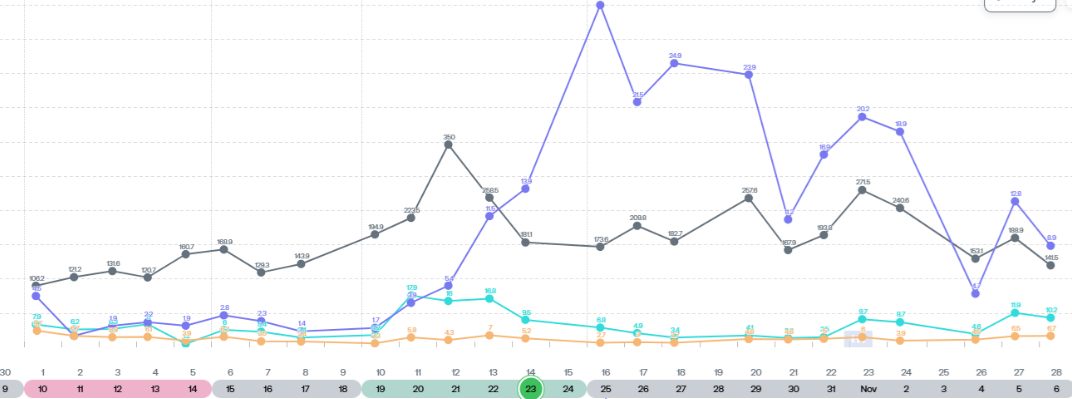
A slow rise in E3G (metabolite of estradiol), which triggers an LH peak, followed by a dip in E3G and a rise in PdG (metabolite of progesterone), with a smaller peak in E3G during luteal phase and then fall of both E3G and PdG which coincides with menses and the start of a new cycle.
Book a complimentary consultation with me to discuss your Mira hormone tracking case. I will offer expert insight with an experienced perspective.
*note this is only for clinicians and no medical advice will be given